


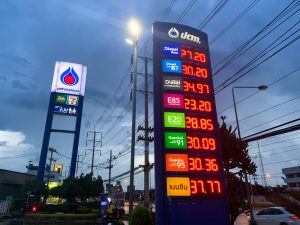
When disruptions to shipping through the Strait of Hormuz sent shockwaves through global energy markets last month, Thailand faced an immediate fuel crunch. Despite assurances from newly elected Prime Minister Anutin Charnvirakul, leader of the Bhumjaithai Party, that the country held three months of reserves, prices surged, petrol stations began rationing within days, and in some parts of the country, motorists queued at pumps for hours. The crisis exposed not only the fragility of Thailand’s fuel supply chain but also the depth of a long-standing illicit fuel trade already running through it.
Cross-border fuel smuggling has long plagued Thailand’s borders, but it escalated sharply in the south from 2009 onward. Malaysia’s heavily subsidized RON95 petrol and diesel, which is cheaper than Thailand’s equivalents, flowed north through Sadao, Padang Besar, and other southern crossings. The trade also moved by sea along the Andaman Sea coast to the west and through the Gulf of Thailand to the east, with the Gulf route expanding significantly in recent years. In the opposite direction, Thai fuel flowed to Cambodia, Myanmar, and Laos whenever price gaps favored it. Both directions were sustained by entrenched criminal networks and corrupt elements within the state apparatus.
Cambodia had relied on Thailand for roughly 30 percent of its fuel imports before last year’s border conflict severed legal channels. Illicit networks moved in quickly to fill the gap, with the Gulf of Thailand serving as the main route. As Thailand’s diesel briefly undercut unsubsidized Malaysian diesel by more than five baht per liter during the worst of the recent shortages, an unexpected southward flow emerged alongside the traditional northward Malaysian RON95 trade, both of them moving simultaneously through southern border crossings.
Fuel smuggling, hoarding, and stockpiling have spread well beyond Thailand’s southern borders. From Myanmar border crossings in Kanchanaburi and Tak to Cambodia border posts in Surin and central depots in Ang Thong and Nakhon Sawan, operators and middlemen raced to accumulate stock ahead of further price rises, worsening the shortages.
Certain politicians have begun demanding answers about the true scale of what officials have so far been reluctant to quantify. Warong Dechgitvigrom, leader of the royalist-conservative Thai Pakdee Party, alleged in parliament on April 9 that March’s missing diesel could total 727 million liters nationwide – far above confirmed figures. He demanded that Anutin’s government explain what he called a “national oil heist.” The figures may be disputed, but what investigators were already uncovering told a similar story.
Surat Thani
Surat Thani province in Thailand’s upper south provided the most damning evidence. Officials from the Department of Special Investigation (DSI) who inspected six depots there in early April discovered that 57 million liters of diesel – roughly a full day’s national consumption – had never reached their designated destinations. Tankers had made 96 trips carrying 217 million liters from Chonburi and Rayong refineries, yet only 160 million liters arrived at the depots. Justice Minister Rutthapon Naowarat noted on April 7 that final figures could climb even higher.
Investigators revealed how dormant companies were reactivated as fronts for depot contracts, concealing the identities of those directing the operation. Fuel was shipped from the refineries, but tanker crews lingered in the Gulf awaiting smaller vessels that transferred the diverted cargo to floating storage depots anchored beyond Thai waters, outside the reach of Thai authorities, before being resold.
This is a pattern Thai anti-smuggling officials say they have seen many times: paperwork shows the fuel arrived, but it never did. Some was smuggled out by sea, some was stockpiled and released once prices peaked, and some was sold across borders. At ten baht or more per liter on 57 million liters, the scheme would have generated profits exceeding 570 million baht ($17.8 million).
PC Siam Petroleum was the most problematic of the six depots in Surat Thani, as its beneficial ownership was concealed behind layers of nominee structures that investigators are still unraveling. On April 9, DSI’s Special Case Committee unanimously designated the case a special investigation – a classification that unlocks court-authorized powers to intercept communications and trace financial flows – with DSI, the Royal Thai Police, the Maritime Enforcement Command Center, the Marine Department, Customs, and the Anti-Money Laundering Office all participating. The company denies wrongdoing and has threatened defamation claims.

Thai Prime Minister Anutin Charnvirakul chairs a cabinet meeting relating to the conflict in the Middle East, in Bangkok, Thailand, Mar. 2, 2026. (Photo credit: Facebook/Bhumjaithai Party)
Justice Minister Rutthapon confirmed that investigators know the fuel’s destinations but declined to name them publicly, sparking widespread suspicion that the bulk ended up in Cambodia. Naowarat’s reticence sat uneasily alongside Prime Minister Anutin’s declaration, just days earlier, that those smuggling fuel across the border were traitors to the nation. People’s Party MP Supachot Chaiyasaj told parliament that the navy had been detecting these maritime transfers all along, but that it simply never made the news.
What Supachot described was not new intelligence. Naval patrols had been logging suspicious transfers in the Gulf for years, tracking vessel movements, recording transfer points, opening cases, and making arrests. What appears to have been absent was not knowledge but the will to act on it. For a growing number of opposition MPs, the question of who had suppressed that will – and why – pointed directly at the government now tasked with answering it.
A Government Under Scrutiny
Anutin’s Bhumjaithai-led government entered office in mid-March already on the back foot. The February 2026 election was disputed by opposition figures, including the People’s Party, the pre-election favorite, amid widespread allegations of vote-buying and irregularities. The party also faced unresolved suspicions of ties to transnational scam networks and grey capital flows.
Those doubts about the government’s integrity gained fresh ground after March 28, when Anutin dismissed the fuel shortages as a problem of public panic and hoarding rather than organized smuggling operations. Within days, the details emerging from Surat Thani told a different story.
The appointment of Deputy Prime Minister Phiphat Ratchakitprakarn to lead the crisis response committee drew immediate criticism. Phiphat is the founder of PTG Energy, Thailand’s second-largest fuel retail network, built on a family business that began by supplying fuel to fishing fleets in the Andaman Sea and grew into one of the south’s largest maritime transport operations. A Songkhla native, he has served as Bhumjaithai’s key political operator across the southern region for more than a decade, playing a central role in eroding the Democrat Party’s once-dominant grip in the region. His brother Phitak is CEO of PTG Energy; another brother, Phibun, holds a Satun parliamentary seat under the same party banner; and his son Chalat sits in parliament on the Bhumjaithai party list. He retained a residual shareholding in PTG when he entered politics in 2019. Opposition MPs described the appointment as a structural conflict of interest; a Bangkok Post editorial called it “a game in which the referee was also a player,” and calls to boycott PT stations have spread across social media since the shortages.
Facing criticism from within the establishment as well as mounting parliamentary and public pressure, including a complaint filed by royalist activist and serial petitioner Srisuwan Janya alleging that Phiphat had failed to act against profiteers and caused public hardship through neglect of duty, Anutin replaced Phiphat on April 2 with Finance Minister Ekniti Nitithanprapas, a technocrat seen as less compromised by commercial entanglements.
The switch did little to quiet the criticism. On April 10, People’s Party MP Rangsiman Rome used the parliamentary policy debate to allege a relationship between Phiphat and a figure at the center of one of the hoarding cases. The 33-year-old Rangsiman, a former student activist and one of the progressive bloc’s most combative parliamentary voices, claimed that Sia Tue, a businessman whose company’s fuel cache was seized in Ang Thong in late March, held loan contracts with Phiphat totaling over 100 million baht ($3.1 million), and that a member of Sia Tue’s family had donated one million baht to the Bhumjaithai Party in November 2025. He called on Anutin to investigate whether those financial ties explained the government’s reluctance to pursue the Ang Thong case aggressively – allegations Phiphat has not publicly answered. Rangsiman’s allegations about Sia Tue, including his involvement in border casinos, scam network connections, and large-scale fuel hoarding, traced the same geography as the missing diesel itself: south and east, toward Cambodia.
Sia Jo and the Limits of Enforcement
Cambodia looms large over the crisis – as both a destination for the missing fuel and the focal point of Rangsiman’s broader allegations about political patronage and grey capital. In December 2025, with fighting raging along their land border, the Thai military imposed a maritime blockade of the Gulf of Thailand to cut off fuel reaching Cambodia by sea – one that has clearly failed. Sor Soputra, the governor of Stung Treng province in Cambodia’s north, acknowledged in March that Thai fuel was still entering Cambodia by land via Laos, prompting Thai Army denials and claims of media mistranslation. For a government whose alleged ties to Cambodia’s grey economy, including scam compounds, border casinos, and money laundering networks, have become a defining line of opposition attack, the destination of the missing diesel is both an investigative question and a political one.

LNG and petrol tanks at Laem Chabang seaport in Chonburi Province, Thailand, Mar. 17, 2019. (Photo credit: ID 162092179 © Klodien | Dreamstime.com)
Thailand’s increasingly estranged eastern neighbor is also where the trade’s most wanted figure allegedly operates, and Thai media have raised questions about his possible role in the current crisis. Sahachai Chiansoemsin, aka Sia Jo, is a Chinese-Thai businessman with interests spanning fishing, timber, currency exchange, and, above all, fuel. According to military sources, his cross-border maritime operation was generating around 200 million baht ($6.3 million) per month before his 2014 arrest. Thai authorities have found no direct evidence formally linking the Surat Thani case to his networks. But a reliable source in the south’s Fourth Army offers a different account: the maritime networks moving fuel to Cambodia belong to Sia Jo. In other words, the same network, the same model, is still in operation – and, according to a source in the Fourth Army, still growing.
Sia Jo’s history with Thai law enforcement is a study in how these networks outlast attempts to dismantle them. He fled Thailand to avoid arrest in 2014, but was reportedly seen returning to his Pattani residence multiple times without arrest. When rearrested in Bangkok in 2021 on money laundering charges, he was found carrying a Cambodian passport and released within two days after police claimed a relevant warrant could not be located. The Courts of Justice later confirmed that the warrant had been issued in 2014 and never cancelled. In June 2024, three fuel smuggling vessels held as evidence disappeared from a Marine Police dock in Sattahip; investigators concluded they had been moved to Cambodia on Sia Jo’s instructions. A 15th arrest warrant was issued in July 2024. It has not been executed. The money laundering case finally reached court in 2025, 13 years after the initial vessel seizure. As one former official noted in the context of the Surat Thani investigation, that timeline “is likely to add pressure on investigators to show that this case will not follow the same path.”
In 2015, an investigation into human trafficking camps in Songkhla’s Sadao district, a territory where fuel smuggling has long operated alongside other illicit trades, reached a serving lieutenant general and local politicians before momentum dissolved. The lead investigator, Pol. Maj. Gen. Paween Pongsirin was transferred to the conflict-ridden Deep South under circumstances he regarded as threatening and eventually fled to Australia.
Both Rangsiman and Paween aimed high. Paween said publicly that his investigation would have reached more senior figures had it been allowed to continue. It wasn’t. In later interviews from Australia, he stopped short of naming names, but those familiar with the political landscape at the time had little difficulty reading between the lines. Nearly a decade later, the pattern is similar: Rangsiman is now targeting a sitting deputy prime minister over the fuel crisis. Whether the outcome is different this time remains to be seen, but the historical record does not warrant optimism.
Thailand’s fuel smuggling networks were in place long before the 2026 fuel crisis brought them into view, and they will remain in place long after the crisis fades. The networks do not depend on any particular government’s tolerance, as they have outlasted successive governments. What the current moment has done is make them briefly visible, and force a question that Thai politics has historically preferred to leave unanswered: not where the fuel goes, but who makes the smuggling possible.